
5 Ways Social Platforms Accidentally Broke Community Communication
Table of Contents
For years, social platforms promised organizations a simple way to reach their communities. Build a following, post consistently, and your message will be seen. In theory, this created connection at scale. In practice, it quietly broke how communities communicate.
Community communication tools are essential for organizations to connect effectively with their audiences.
Utilizing effective community communication tools can enhance engagement and increase visibility for important messages.
Today, organizations can have thousands of followers and still fail to reach the very people who asked to hear from them. Important updates are missed. Events go unnoticed. Resources go unused. Leaders are left wondering what went wrong.
The answer is not declining interest. It is the way social platforms are built.
By implementing community communication tools, organizations can better manage information flow. This is where community communication tools play a vital role in ensuring messages are delivered.
Effective community communication tools can bridge this gap and improve overall interaction.
1. Followers Do Not Equal Reach in Community Communication
One of the biggest misconceptions in community communication is that followers equal visibility. On most social platforms, that is no longer true.
Algorithms decide which posts appear in a user’s feed based on predicted engagement, past behavior, and platform priorities. Even when someone follows an organization, there is no guarantee they will see its updates. In many cases, only a small percentage of followers are reached organically.
Organizations using community communication tools can ensure their updates are prioritized.
For communities, this creates a fundamental breakdown. Members believe they are staying informed by following an organization, while leaders believe they are communicating by posting. In reality, the system filters most messages out.
Investing in community communication tools helps organizations maintain their connection with their audience.
This gap is one of the core reasons community communication tools built on social platforms fail.
2. Important Community Updates Compete With Viral Content
Social platforms are optimized for content that keeps people scrolling. Viral videos, trending topics, and sensational posts consistently outperform practical community updates in algorithmic ranking.
With suitable community communication tools, leaders can enhance trust and engagement.
A nonprofit sharing resources, a chamber announcing an event, or a local organization posting an important update is competing with entertainment content designed to capture attention quickly. The algorithm does not understand urgency or importance. It understands engagement signals.
Community communication tools are necessary to streamline communication efforts.
As a result, critical community information often loses visibility, regardless of how valuable it is. Members do not miss updates because they do not care. They miss them because the platform deprioritized them.
3. Pay to Play Became the Default Community Communication Model
As organic reach declined, paid promotion became the workaround. Organizations now spend money to boost posts, promote events, and advertise updates just to reach a fraction of their own audience.
Relying solely on social platforms without community communication tools can hinder progress.
This pay to play model creates a hidden cost for communities. Budgets are drained simply to maintain basic communication. Leaders justify minimal results because the system normalized low reach.
Community communication tools can provide a stable foundation for effective engagement.
Using community communication tools also allows for better tracking of interactions.
Over time, this erodes trust in community communication tools and forces organizations into a cycle of spending more for diminishing returns.
Transitioning to dedicated community communication tools is a step towards better organization.
Community communication tools can also provide essential insights for improvement.
With community communication tools, organizations can create a more engaged audience.
Investing in the right community communication tools increases overall effectiveness.
4. Fragmentation Weakens Community Engagement
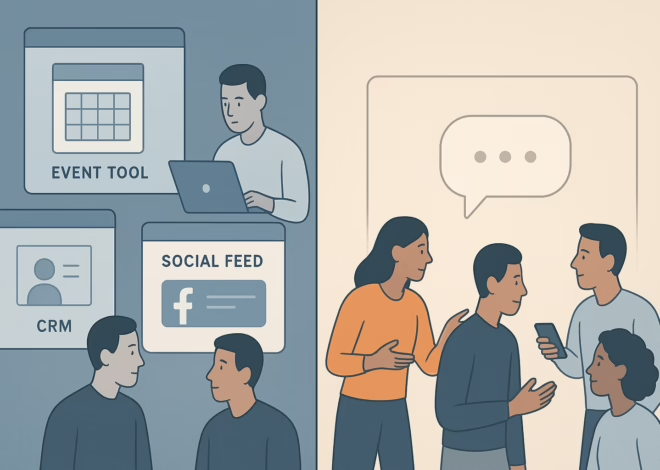
Because social platforms are unreliable, organizations add more tools. Email for announcements. Event platforms for registrations. Messaging apps for conversations. CRMs for contacts.
Ultimately, community communication tools foster a more connected environment.
Each tool solves one problem, but together they fragment the community experience. Members are expected to check multiple platforms to stay informed. Important updates are scattered. Context is lost.
Fragmentation is one of the most overlooked causes of low community engagement. When there is no clear place to go, participation becomes inconsistent, even for highly motivated members.
5. Social Feeds Were Never Designed to Be Community Homes
At their core, social platforms are feeds. Feeds are transient. Content disappears quickly, replaced by whatever the algorithm decides is next.
Communities need stability. They need a consistent place where information lives, where members can find updates, events, and resources without relying on timing or chance.
When organizations try to use feeds as community infrastructure, they fight against the design of the system. The result is frustration on both sides.
Community communication works best when it is built on ownership, clarity, and predictability, not algorithms.
What Community Communication Needs Instead
To fix community communication, organizations need to move beyond social platforms as their primary system.
A strong community communication platform should provide:
• Reliable delivery of updates without algorithm interference
• A centralized home where members know where to look
• Clear visibility into events, resources, and announcements
• Fewer tools, not more
When communication is owned instead of rented, communities become easier to serve and easier to grow.
Social Platforms Did Not Fail Communities on Purpose
Social platforms did not set out to break community communication. They evolved to serve different goals. The problem is not misuse. It is mismatch.
Communities need systems designed around connection, clarity, and continuity. When those systems exist, engagement follows naturally.
Ready to Build Better Community Communication?
Kannect gives organizations a dedicated home for community communication, discovery, and engagement. It removes algorithm interference, reduces tool overload, and helps members stay informed in a way that actually works.
Choosing community communication tools over traditional methods can yield better results.
If you are tired of competing for attention just to reach your own community, it may be time to rethink the system you are using.
Learn how Kannect helps communities communicate without fighting algorithms.
Helping organizations thrive, members participate, and communities flourish.
Frequently Asked Questions
Why do social media platforms limit community reach?
Social media platforms use algorithms to prioritize content that maximizes engagement and time spent on the platform. Community updates often do not generate the same signals as viral content, which leads to reduced visibility even for followers.
Are social platforms considered effective community communication tools?
Social platforms can support awareness, but they are not reliable community communication tools. They lack guaranteed delivery, centralized organization, and control over visibility, which are essential for effective community engagement.
Why do organizations have to pay to reach their own followers?
As organic reach declined, platforms introduced paid promotion as a way to increase visibility. This pay to play model prioritizes revenue over consistent communication, forcing organizations to spend money to reach audiences they already built.
How does fragmentation impact community engagement?
Fragmentation spreads communication across multiple tools, making it harder for members to stay informed. When people do not know where to look for updates, participation drops even if interest remains high.
What is the best alternative to social platforms for community communication?
The most effective alternative is a dedicated community communication platform that provides a centralized home for updates, events, and resources without algorithm interference.
How does Kannect improve community communication?
Kannect provides organizations with a dedicated space where community members can reliably discover updates, events, and resources. It reduces dependence on social feeds and gives both leaders and members clarity about where communication lives.

Related Posts

10 Signs You Need a Community Engagement Platform Built for Discovery, Not Algorithms

7 Ways Community Engagement ROI Proves Your Platform Is Either Working or Failing