

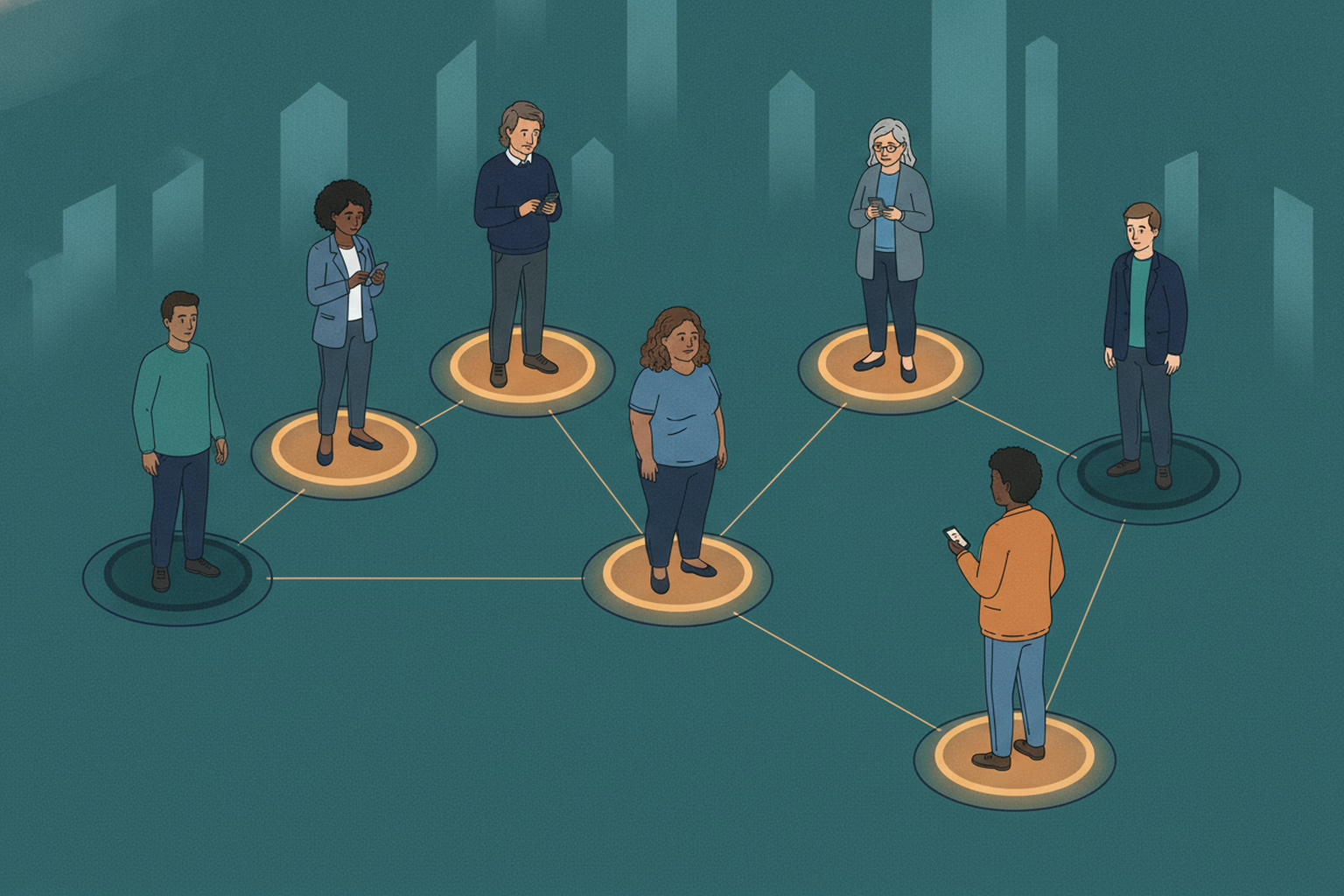
Members not seeing announcements is the most common complaint we hear from organizations, and it’s almost always diagnosed wrong. The board decides people aren’t paying attention, or that the newsletter needs a redesign, or that somebody should post more.
Usually none of that is the problem. You have four channels, each one leaks in a specific and predictable way, and the leaks compound. Once you can name which one is failing, the fix is usually small and boring.
Here’s what actually happens to an announcement between you writing it and a member knowing about it.
On this page
Members not seeing announcements: the four channels and how each leaks
Most organizations use all four. Each fails differently, which is why a single fix rarely works.
| Channel | Who it reaches | How it leaks | Can you measure it? |
|---|---|---|---|
| The room | People who already came | Reaches the group least in need of telling | Yes, you can see them |
| Facebook or a social group | Whoever an algorithm picks | Group posts compete against friends and family in the same feed | Per post only, and Meta publishes no benchmark |
| Whoever opens, if it arrived | Roughly one in six nonprofit emails never reaches an inbox | Poorly, since machine opens inflate the number | |
| Word of mouth | The well connected | Skips newcomers, the recently bereaved, the quietly drifting | No |
That last column matters more than it looks. Three of your four channels can’t tell you what they did, so the failure is invisible until somebody turns up on the wrong night.
Why the leaks compound
Organizations tend to think of the four channels as four chances, as though using all of them adds up to full coverage. They overlap far more than that.
The member who reads your email is usually also the member who reads your Facebook post, comes to meetings and hears things from a friend. That’s what being engaged means. So adding a fourth channel mostly reaches the same people a fourth time.
The member who saw none of it is the one who joined in March, hasn’t been to anything since, isn’t friends with anyone in the group, and whose email address was typed in wrong at signup. No amount of posting reaches that person. A working contact record does.
Which is the real reason this problem is so persistent: it looks like a communication problem and it’s usually a records problem.
Diagnosing why members are not seeing announcements
Do this before changing anything. It takes about twenty minutes and it will probably surprise you.
- Count who you actually have. Not average attendance. A list of names with a working way to reach each one. Most organizations discover this list is smaller and staler than they assumed, and that number is the ceiling on everything else.
- Take your last announcement that mattered and, for each channel, write down how many people it reached. Email opens, group post reach, people in the room. Rough is fine.
- Ask five members who missed it. Not the regulars. The ones who weren’t there. Ask what they check and what they’d have wanted. Five conversations beat any amount of analytics.
- Check whether your email is arriving at all. Send one to a Gmail, an Outlook and a Yahoo account you control and see where it lands. Validity’s benchmark put nonprofit inbox placement at 83.5%, so roughly one in six never made it.
- Count how many announcements you sent last month. If it’s more than about four, the problem may be the opposite of the one you think.
Two of those steps have longer articles behind them. On the social side, what Facebook group reach actually is explains why Meta gives you a per-post number and no benchmark. On email, email open rates for small organizations covers why the number you’re looking at is inflated.
The fix, in order of effort
Cheapest first. Most organizations get most of the way with the first three.
- Fix the list. Bounced addresses, typos, people who joined and were never added. This is dull, free, and usually the single biggest win.
- Send fewer, clearer announcements. A congregation or membership that gets eleven messages a week stops reading all of them. Pick the two that matter.
- Write for the person who wasn’t there. Most announcements assume context only regulars have. Name the thing, the date, the place, and what you want the reader to do.
- Collect a second channel, with consent. Usually a mobile number. It’s the highest-reach channel available and it’s useless without opt-ins, so start collecting them at the next meeting whatever software you end up with.
- Decide who owns it. Announcements usually fail because they belong to everyone, which means nobody. One person, one calendar.
- Stop depending on a channel that can’t tell you what it did. If a message genuinely has to reach people, it shouldn’t be routed through something that decides for itself who sees it.
The opposite failure: too many announcements
Worth naming, because the fix for one problem creates the other. An organization that reacts to poor reach by sending more ends up training members to ignore it, and then the important message lands in a stream people have already tuned out.
The signal to watch is unsubscribes and quiet drift rather than complaints. M+R put annual nonprofit list loss at around 12%. If yours runs well above that, you are probably sending too much rather than too little. We wrote about the balance in community notifications: engaging members without overwhelming them.
Where Kannect fits
Kannect is our product, so check the pricing page yourself. It’s a community engagement platform for membership organizations, staffed or volunteer-run.
Memberships, properly. One membership type with multiple pricing tiers on every plan, or multiple membership types each with their own tiers on the higher plans. Custom application forms, manual or automatic approval, and a welcome flow that drops a new member straight into the conversation. Discounts and renewals are built in.
And the rest of the organization. A member directory with unlimited listings, groups and programs for chapters and committees, a people database with statuses for member, alumni, donor, staff, parent and student that members keep current themselves, events, broadcast email, a community website and a member app.
| Plan | Monthly | Billed yearly | People | Admins | Emails/mo | Platform fee |
|---|---|---|---|---|---|---|
| Starter | $29 | $276 | 500 | 3 | 5,000 | 2% |
| Launch | $69 | $660 | 2,000 | 5 | 20,000 | 2% |
| Growth | $149 | $1,428 | 5,000 | 10 | 50,000 | 1.5% |
| Scale | $299 | $2,868 | 15,000 | 25 | 150,000 | 1% |
On the problem in this article: every opted-in member receives every announcement. No algorithm decides who sees it and there’s no per-contact overage bill for sending it. And because members maintain their own profile from the app, the list stops rotting, which is the underlying cause more often than anything to do with wording.
What it won’t fix is a message nobody wanted. If members are tuning out, sending the same thing more reliably just delivers the tuning out faster. The list fix and the fewer-announcements fix come first, whatever you run them on.
Most organizations start with one job, usually events, payments or the directory, and bring the rest across as they need it. Setup is self-serve at no cost, with an optional one time setup service starting at $150.
We write separately for chambers, nonprofits, churches, K-12 and PTAs and support groups.
Frequently asked questions
Why are members not seeing announcements?
Usually because each channel leaks in a different way and the leaks overlap. The room reaches people who already came. A social group post competes against friends and family in the same feed. Email reaches the inbox only about 83.5% of the time for nonprofits. Word of mouth reaches the well connected. The member who misses everything is typically the one with a stale contact record, not the one ignoring you.
How do I know which channel is failing?
Take one announcement that mattered and write down, per channel, how many people it reached. Then ask five members who missed it what they actually check. Then send a test email to accounts on the major providers to see whether it lands in the inbox at all. Twenty minutes of that beats redesigning a newsletter.
Should we send announcements more often?
Usually not, and it often makes things worse. An organization that responds to poor reach by sending more trains members to ignore it. Watch unsubscribes and quiet drift rather than complaints. M+R put annual nonprofit list loss at around 12%, so a figure well above that suggests over-sending rather than under-sending.
Is texting better than email for announcements?
For the small number of things that genuinely must arrive, such as a cancellation or a venue change, yes, because reach is far higher. The constraint is consent, so you need opt-ins before software helps. Email remains the better channel for weekly detail. Most organizations need both, used for different jobs.
Why does our Facebook group post reach so few members?
Group posts get no protected lane in the feed. Meta’s own ranking documentation puts them in the same inventory as posts from friends and followed Pages, scored by over 100 prediction models, with the system narrowing to roughly 200 candidate posts per person. Group size is itself a ranking signal. Nothing in Meta’s documentation promises delivery to members.
What is the first thing to fix?
The list. Bounced addresses, typos and members who joined but were never added. It costs nothing, it is the least interesting task on the list, and it is almost always the biggest single improvement. Everything else is capped by how many people you can actually reach.
Where these figures came from
Two outside figures are quoted above. Both came from the organization that published them, read on 6 September 2026.
- Validity: email deliverability benchmark, nonprofit inbox placement
- M+R Benchmarks: nonprofit email and list churn
- Meta Transparency Center: how Facebook feed ranking works
Related reading
- What Facebook group reach actually is in 2026
- Email open rates for small organizations
- Community notifications without overwhelming members
- Why community engagement fails
- Why members join and then go quiet
- How to reach every member without paying to boost your post
- The hidden cost of running your community on Facebook Groups
- 10 emails every community should automate