

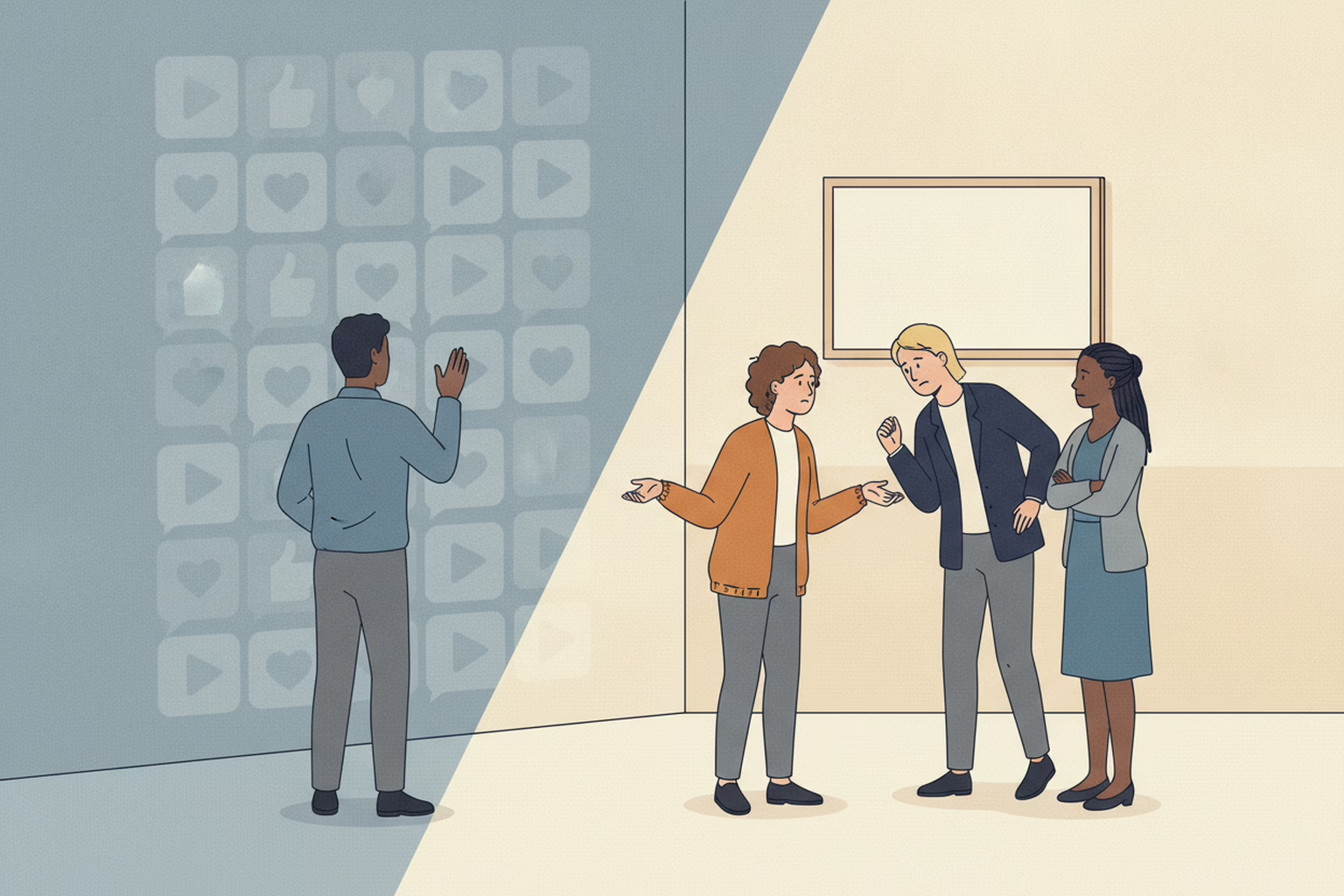
Search for a Facebook group reach figure and you’ll find plenty of them. Groups reach 30% of members. Group posts get ten times the reach of a Page. Organic reach is 5.2%. Pick whichever one suits your argument.
Here’s the problem with all of them. We went looking for the original source of every Facebook group reach statistic we could find, and there isn’t one. Not a stale one, not a disputed one. Meta has never published an organic reach figure for Groups, and since it shut off third-party access to Groups data in 2024, nobody outside Meta has the means to calculate one.
That sounds like a dead end. It isn’t, because what Meta does publish tells you more than a percentage would.
On this page
What Meta actually gives a group admin
Meta’s help documentation lists exactly what Group Insights reports: member growth and membership requests, posts, comments and reactions, active members, popular days and popular times, top posts, top contributors, top admins and moderators, and, in groups over 250 members, age, gender and top locations.
Reach is not in that list. There is no reach metric at group level, no reach trend line, and no percentage of any kind.
Post-level reach does exist. Meta defines it as “the number of people who saw the post at least once,” flags it as estimated, and adds one detail worth holding onto: “For public groups, this number includes both members and non-members.” It needs a group of at least 250 members, and it only covers posts made after the feature reached your group.
Below 250 members you get something better and stranger. Meta will show you the names of the members who have seen a post, as long as anonymous participation is off. Above 250 the names disappear and you get a count.
Meta gives you both numbers and never divides them
This is the heart of it. Meta hands you the numerator, which is how many people saw the post. It hands you the denominator, which is your total member count. It never, anywhere, puts one over the other.
No rate. No average. No benchmark. Not for your group, not for groups of your size, not for groups in general. There is no Meta document, in the Newsroom, the Transparency Center or the Business Help Centre, that states an organic reach figure for Groups.
And no outside party can fill the gap. The Groups API never had an insights endpoint, and in January 2024 Meta announced it was removing third-party access to Groups data entirely, with 90 days notice. Whatever benchmark someone might once have built, the raw material for it no longer exists.
So when an article tells you Facebook groups reach a given percentage of members, there are only two possibilities. Either it is extrapolated from Facebook Pages data, which measures a structurally different product, or somebody made it up.
What Meta says about how group posts get ranked
Meta’s Transparency Center describes the Groups Feed system, updated in March 2025, and it makes one quantitative claim: the system “narrows the pool of eligible content to approximately 200 of the most relevant posts for you,” scores them, and orders them.
The main Feed documentation, updated June 2025, is more useful still. Group posts don’t get a protected lane. They sit in the same inventory as posts from friends and followed Pages and compete against them, scored by what Meta says is over 100 prediction models. Among the signals it lists explicitly:
- The number of members in the group, listed as a ranking signal in its own right
- Your total views of other posts from that group
- How likely you are to be interested in the group, measured by your past engagement with it
- A diversity rule: you are less likely to see several posts from the same group in a row
Read that list again with an announcement in mind. Nothing in it promises delivery to members. It is a description of a competition your meeting notice enters, against your members’ friends and family, and mostly loses.
The one number Meta does publish about groups is worth knowing so you don’t misread it. In its Widely Viewed Content Report, Meta says posts from joined groups made up 14.6% of organic Feed content views in the US in the second quarter of 2026, up from 14.3% in the first. That’s the share of everything everyone saw on Feed. It says nothing about how many of your members saw your post, and it should never be converted into a reach figure.
Why every stat you have read is about Pages
Facebook Pages reach is measurable, because Pages data is available to analytics vendors. Groups is not. Almost every reach figure in circulation is a Pages figure that has quietly lost its label.
The most recent original Pages study we could verify is Socialinsider’s, published on 3 September 2026, covering 872,075 posts by brand pages between January 2025 and August 2026. It puts average Facebook reach rate at 1.25%, defined as total reach divided by total followers.
| Page followers | Reach rate |
|---|---|
| 1,000 to 5,000 | 4.35% |
| 5,000 to 10,000 | 3.40% |
| 10,000 to 50,000 | 2.70% |
| 50,000 to 100,000 | 1.50% |
| 100,000 to 1 million | 0.50% |
The pattern is the interesting part: the bigger the audience, the smaller the share that sees anything. If that shape holds for groups, and nobody can prove it does, then growing your group is not the same as growing your reach.
Two corrections while we’re here, because both get cited constantly. Rival IQ is frequently quoted for reach figures and does not measure reach at all; its benchmark report covers engagement rate. And Hootsuite’s widely shared Facebook numbers are attributed in its own post to a third party rather than to Hootsuite research.
How to measure your own group reach in ten minutes
You can’t benchmark your group against anyone else’s. You can absolutely measure your own, and it’s the only number that should affect your decisions.
- Pick your last five real announcements. Not the chatty posts. The ones where it mattered that people knew: a meeting time, a cancellation, a deadline, a call for volunteers.
- Open each one and note the reach figure. Post insights, groups of 250 members or more. Write down the five numbers.
- Divide each by your member count. That’s your reach rate, for that post. Meta won’t do this for you, which is the whole point of this article.
- Average the five. Now you have a defensible number for your group. Not a benchmark, but yours, and real.
- Do the same for your most-liked social post. Compare. Most organizations find the post that reached the most people is not the one that mattered most.
- If your group is under 250 members, do it properly. Turn off anonymous participation and read the actual names of who saw it. Then compare that list against the people you needed to reach.
Two cautions on the arithmetic. In a public group, the reach count includes non-members, so your rate is flattered. And the number is estimated, which Meta says plainly.
Whatever your figure turns out to be, the question that follows is the same one: is it acceptable for a message that people need to receive? For a discussion thread, low reach is fine. For a cancellation, it isn’t, and the fix is not a better Facebook post. There’s more on that in why your members never see your announcements and in our guide on the hidden cost of running your community on Facebook Groups.
Where Kannect fits
Kannect is our product, so check the pricing page yourself. It’s a community engagement platform for membership organizations, staffed or volunteer-run.
Memberships, properly. One membership type with multiple pricing tiers on every plan, or multiple membership types each with their own tiers on the higher plans. Custom application forms, manual or automatic approval, and a welcome flow that drops a new member straight into the conversation. Discounts and renewals are built in.
And the rest of the organization. A member directory with unlimited listings, groups and programs for chapters and committees, a people database members keep current themselves, events, broadcast email, a community website and a member app.
| Plan | Monthly | Billed yearly | People | Admins | Emails/mo | Platform fee |
|---|---|---|---|---|---|---|
| Starter | $29 | $276 | 500 | 3 | 5,000 | 2% |
| Launch | $69 | $660 | 2,000 | 5 | 20,000 | 2% |
| Growth | $149 | $1,428 | 5,000 | 10 | 50,000 | 1.5% |
| Scale | $299 | $2,868 | 15,000 | 25 | 150,000 | 1% |
On the specific subject of this article: every opted-in member receives every announcement. There’s no ranking model between you and them, no 200-post shortlist, and no per-contact overage bill for sending it. You also get the number Meta won’t give you, because delivery to an opted-in list isn’t estimated.
None of which means abandoning your group. Plenty of organizations keep Facebook as the public front door, where strangers find them, and run the actual organization somewhere they control. Those aren’t mutually exclusive.
Most organizations start with one job, usually events, payments or the directory, and bring the rest across as they need it. Setup is self-serve at no cost, with an optional one time setup service starting at $150.
Where these facebook group reach facts came from
Every claim above came from the original publisher, on the date shown. Go and check them, because Meta changes its documentation without announcing it.
- Meta: view insights about a Facebook group you admin
- Meta: view reach and engagement for a post in a group
- Meta: view which members have seen a post
- Meta Transparency Center: the Facebook Groups Feed AI system
- Meta Transparency Center: our approach to Facebook Feed ranking
- Meta Transparency Center: Widely Viewed Content Report
- Meta for Developers: the Group node, Graph API reference
- Socialinsider: social media reach statistics, 3 September 2026
- Rival IQ: social media industry benchmark report
Frequently asked questions
What is the average Facebook group reach?
There isn’t one, and that’s a real answer rather than a dodge. Meta has never published an organic reach figure for Groups in its Newsroom, Transparency Center or Business Help Centre, and since it removed third-party access to Groups data in January 2024 no outside party has the means to calculate one. Any specific percentage you find is either extrapolated from Facebook Pages, which is a different product, or invented.
Can I see how many members saw my Facebook group post?
Yes, for one post at a time. Meta shows post-level reach, defined as the number of people who saw the post at least once, in groups of 250 members or more, for posts made after the feature reached your group. It is estimated, and in a public group it includes non-members as well as members. There is no reach metric at group level and no reach trend over time.
Why do so few members see my group announcements?
Group posts have no protected lane. Meta’s own ranking documentation puts them in the same inventory as posts from friends and followed Pages, scored by over 100 prediction models, with the system narrowing to roughly 200 candidate posts per person. Group size is itself listed as a ranking signal. Nothing in the documentation promises delivery to members.
Do Facebook groups get better reach than Facebook pages?
This is repeated constantly and cannot be traced to any Meta statement. Meta’s ranking documentation describes parallel prediction models for group and Page content and states no preference between them. Since Groups reach is not measurable at scale by anyone outside Meta, no study can support the comparison either.
How do I calculate my own Facebook group reach rate?
Take your last five real announcements, note the reach figure on each, divide each by your total member count and average the five. Meta gives you both numbers but never divides them. In a public group the result is flattered, because reach includes non-members, and the underlying figure is estimated.
Should we leave Facebook groups?
Not necessarily, and it doesn’t have to be a single decision. A Facebook group is a genuinely good front door for finding people who don’t know you yet. Where it struggles is delivery, because you cannot make a specific announcement reach a specific member. Many organizations keep the group for discovery and move dues, records and announcements somewhere they control.
Related reading
- Why your members never see your announcements
- Email open rates for small organizations: what is normal and what is broken
- 12 best community engagement platforms, with verified pricing
- Why community engagement fails
- The hidden cost of running your community on Facebook Groups
- How to reach every member without paying to boost your post
- All 16 free guides and templates