

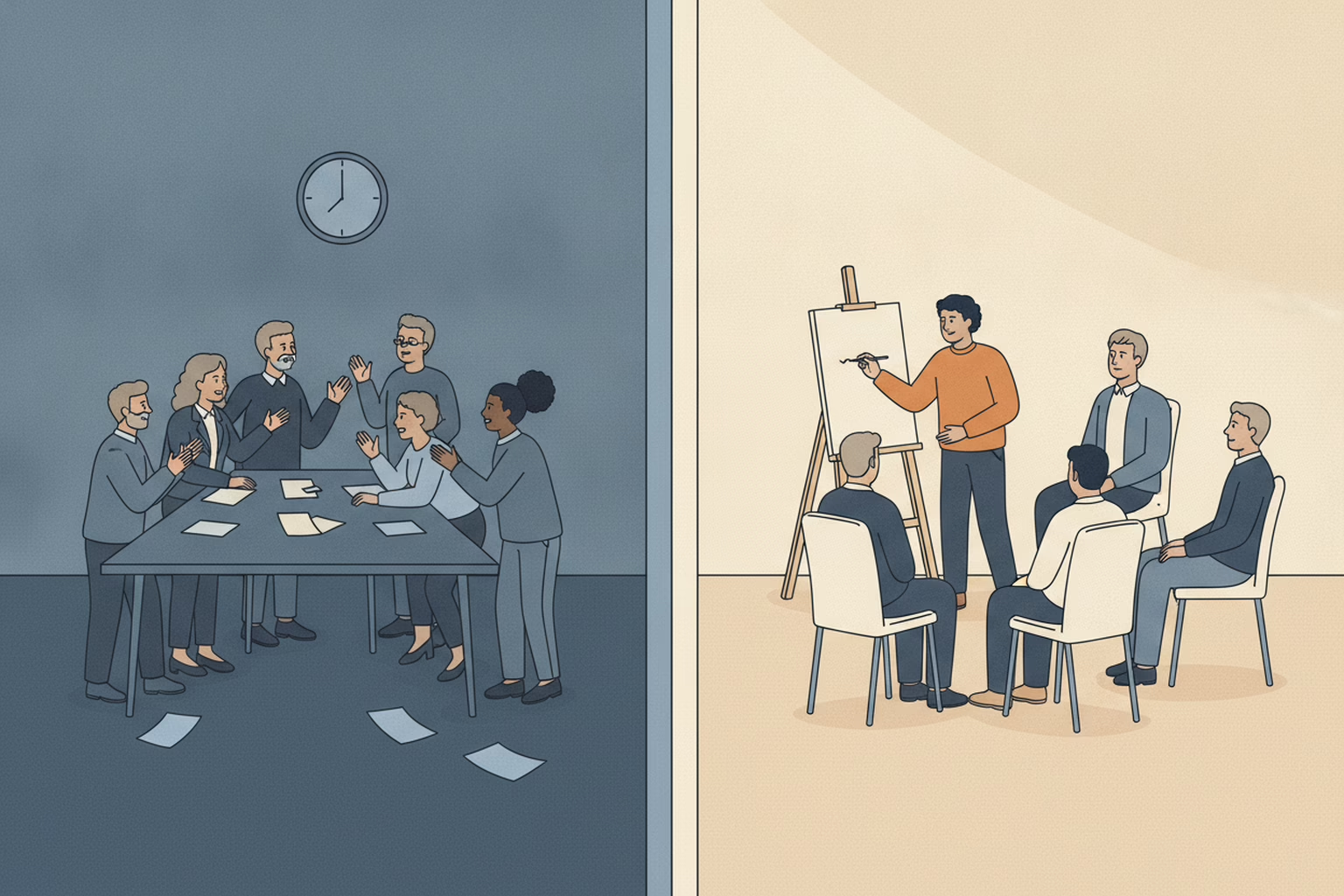
Learning how to run a community meeting is one of the highest-return skills in a volunteer-led organization, because a bad meeting does not just waste ninety minutes. It teaches everyone in the room that showing up is optional, and the next one is smaller.
The good news is that most of what makes a meeting work is mechanical. Send the agenda early, put times on it, name who is deciding what, finish when you said you would, and write down what happened. None of that requires charisma.
On this page
How to run a community meeting: the short version
If you only do these, your meetings will be better than most:
- Send the agenda at least three days ahead, with a time against each item.
- Say at the top which items are for information, which are for discussion, and which need a decision.
- Name a chair, a note-taker and a timekeeper. Three different people.
- Start on time regardless of who is missing, and finish on time regardless of what is unfinished.
- End every item by saying out loud what was decided and who is doing it by when.
- Send the notes within 48 hours, with the decisions and owners at the top.
Everything below is the reasoning and the edge cases.
Before the meeting
Most of how to run a community meeting well is decided before anyone sits down.
Be honest about why it exists. If the purpose is to tell people things, it is a newsletter with worse attendance. Meetings are for the things that need several people in a room at once: deciding something contested, working through a problem, or building the relationships that make the rest of the year easier. Everything else should be written down and sent.
Send the agenda at least three days ahead. The National Council of Nonprofits puts distributing agendas in advance near the top of its guidance on effective board meetings, and the reason is simple: people who read it beforehand arrive with opinions instead of forming them live, which is most of where meeting time disappears.
Attach the reading, and keep it short. Two pages that get read beat twenty that do not. If a decision needs background, the background goes in the pack, not in a fifteen-minute verbal summary at the meeting.
Collect RSVPs. Not for catering. Knowing who is coming tells you whether the item that needs a decision has the right people in the room, and lets you move it if it does not. Deciding something important with half the committee absent is how organizations end up relitigating the same question three times.
Pick a time that fits the people you want, not the people who always come. A standing 7pm weekday slot quietly excludes shift workers and parents of small children. Rotating between two times, or alternating in-person and online, widens who can take part more than any amount of encouragement.
An agenda that ends on time
The agenda is where how to run a community meeting stops being a philosophy and becomes arithmetic. An agenda is a budget. If the items add up to more than the meeting length, you have already decided to overrun, you just have not admitted it yet.
Put a number of minutes against each item, and label each one:
- For information. No discussion planned. Ideally these are not on the agenda at all, but sent in advance and taken as read.
- For discussion. Input wanted, no decision today. Say so explicitly, or half the room will think a decision was made and half will not.
- For decision. A specific question with an answer, named in advance. “Budget” is not a decision item. “Approve the $2,400 field trip subsidy” is.
A consent agenda is worth borrowing from formal governance: bundle the routine approvals, minutes and small reports into one item, pass them together, and pull out anything somebody actually wants to talk about. It routinely saves twenty minutes.
Two more habits. Put the hard item second rather than last, when people are alert and nobody is watching the clock. And keep a visible parking list for good ideas that are not today business, so raising one is neither rewarded with twenty minutes of drift nor punished with a flat no.
The three roles in the room
Anyone learning how to run a community meeting discovers this the hard way. Small organizations tend to give all three of these roles to whoever is in charge, which is why that person ends up unable to take part in the discussion they are running.
The chair moves things along, brings quiet people in, and decides when a discussion is finished. The main skill is closing an item: naming the decision, checking nobody is silently unhappy, and moving on. A chair who cannot end a discussion will run a meeting where the loudest person sets the agenda.
The note-taker records decisions, owners and deadlines. Not a transcript. If the notes cannot be skimmed in two minutes by somebody who missed the meeting, they are too long to be useful.
The timekeeper says out loud when an item has five minutes left. It sounds bureaucratic and it is the single change that most reliably shortens meetings, because it makes the trade-off visible while there is still time to make it.
Rotating these roles is worth doing on purpose. It spreads the skill, it stops one person owning the meeting, and people who have chaired once are noticeably better participants afterwards.
For formal decisions, some groups adopt parliamentary procedure. Robert’s Rules of Order is the common reference in the United States, and it is genuinely useful for contested votes and for organizations whose bylaws require it. For a committee of nine deciding on a bake sale, it is overkill, and imposing it tends to make people who are unfamiliar with it stop speaking.
How to actually make a decision
The most common failure in a community meeting is not a bad decision. It is a meeting that felt like it decided something and did not, so the same discussion happens again in six weeks with slightly different people.
Say the decision rule before the discussion, not after. Is this a vote, is it the chair deciding with input, or is it the committee that owns the area deciding and telling everyone? All three are legitimate. What is not legitimate is leaving it vague, because then whoever is unhappy afterwards can reasonably claim the process was wrong.
Then close every item with one sentence, out loud, in this shape: we decided X, Y is doing it, by Z date. If you cannot say that sentence, the item is not finished, and you should either finish it or move it explicitly.
A few practical notes:
- Silence is not agreement. Ask directly, especially of the people who have not spoken. “Anyone unhappy with this?” gets better information than “everyone good?”
- Write the owner down as a name. “The events committee” will not do it. A person will.
- Give it a date. An action with no date is a wish.
- Record who was absent for a contested decision. Not to blame anyone, but so it is clear later who was and was not part of it.
When it goes sideways
The hardest part of how to run a community meeting is the evening it stops going to plan. Every community organization eventually has the meeting where an item turns into an argument, or one person will not let something go, or a decision half the room disagrees with has to be made anyway.
The person who will not stop. Usually they do not feel heard. Say back what you understood their point to be, note it in the minutes by name, and then move on explicitly: “that is recorded, we are moving to the next item.” Being written down often does what more talking will not.
An item that becomes a fight. Stop it. Almost nothing has to be resolved that evening, and the version of the argument that happens at 9:40pm in front of an audience is the worst version. Take it to a smaller group with a deadline to bring back a proposal.
A decision people will dislike. Make it, say why, and say what would change it. Ambiguity feels kinder in the moment and reads as evasion afterwards.
A meeting that is going to overrun. Say so with fifteen minutes left and offer the choice: drop an item, or schedule a follow-up. Silently running twenty minutes over is how you lose the people with childcare, who are usually the ones you can least afford to lose.
The 48 hours afterwards
This is the step that decides whether the meeting mattered, and it is where knowing how to run a community meeting pays off, and it is the one most groups skip.
Send the notes within two days, while people still remember. Put the decisions and the actions at the top, with names and dates, and the discussion underneath for anyone who wants it. Anybody who missed the meeting should be able to read the first ten lines and know what happened.
Send them to everyone the decisions affect, not only to the people who attended. A committee that keeps its decisions inside the committee is training the rest of the membership to assume nothing is going on.
For incorporated organizations, this is not only good practice. The National Council of Nonprofits notes that board meeting minutes are legal documents, so what gets recorded, approved and kept matters beyond the convenience of the people in the room.
Then open the next agenda with the actions from the last one and whether they happened. Two minutes, every time. It is the only thing that reliably stops a group from becoming one where being assigned something and not doing it carries no consequence at all.
Running it online or hybrid
How to run a community meeting changes online. Online meetings are not worse, but they are different, and hybrid ones are genuinely harder than either format on its own.
- Shorter. Sixty minutes online is roughly ninety in person. Plan for it rather than discovering it.
- Call on people by name. The social cues that let people find a gap to speak do not survive a video grid, so a chair who waits for volunteers will hear from three people all evening.
- Use the chat deliberately. Ask for a one-word answer in chat before discussing something. You get input from the people who will never unmute, which is often half the room.
- In hybrid, give remote attendees a champion. One person in the room whose job is to watch for raised hands and speak for them. Without it, remote attendees become spectators within ten minutes.
- One microphone for the room, not laptop microphones. If remote attendees cannot hear the discussion, they are not in the meeting, whatever the attendance list says.
- Test it beforehand. The first ten minutes spent on audio problems come out of the agenda, and they set the tone for everything after.
Alternating between formats month to month is worth considering. It widens who can take part, and it stops either group from becoming the second-class one.
Where Kannect fits
Knowing how to run a community meeting is a skill, not a feature. What software handles is the surrounding admin: who was invited, who said they were coming, who actually turned up, and whether the notes reached everyone the decisions affect. Kannect is a membership and community platform for any organization with members, and that is the part it takes off your plate.
- Events with sign-ups. RSVPs collected in advance, so you know before the day whether the decision item has the right people in the room, and attendance recorded afterwards without a paper sheet.
- Groups and programs. Committees, chapters and cohorts each get their own space, so the agenda, the pack and the notes go to that group rather than to the whole organization.
- People CRM. Statuses such as member, alumni, donor, staff, parent and student, so “everyone the decision affects” is a list you can select rather than reconstruct.
- Email to your own list. The agenda three days ahead and the notes within 48 hours, sent to the people you choose rather than to whoever an algorithm decides to show them to.
- Full membership management. One membership type with multiple pricing tiers on every plan, or multiple membership types each with their own tiers on higher plans, plus custom application forms, manual or automatic approval, a welcome flow, discounts and renewals.
- A member directory. One directory with unlimited listings on every plan, and multiple directories on higher plans, so committee members can reach each other between meetings.
Pricing is public and there is no free plan. Every plan includes a 7-day trial and a card is required to start it.
| Plan | Monthly | Billed yearly | People | Admins | Emails/mo | Platform fee |
|---|---|---|---|---|---|---|
| Starter | $29 | $276 | 500 | 3 | 5,000 | 2% |
| Launch | $69 | $660 | 2,000 | 5 | 20,000 | 2% |
| Growth | $149 | $1,428 | 5,000 | 10 | 50,000 | 1.5% |
| Scale | $299 | $2,868 | 15,000 | 25 | 150,000 | 1% |
Payment processing is 2% on Starter and Launch, 1.5% on Growth and 1% on Scale. Donations to a registered nonprofit are processed at 0%.
Here is a short look at how it works:
Related reading
- Event run of show
- How to reach every member
- Why engagement drops after the first event
- Handing a volunteer role to the next person
- The five tool community stack
Common questions about how to run a community meeting
How do you run a community meeting effectively?
Send the agenda at least three days ahead with a time against each item, label items as information, discussion or decision, name a separate chair, note-taker and timekeeper, start and finish when you said you would, close each item by saying aloud what was decided and who owns it by when, and send the notes within 48 hours with decisions and owners at the top.
How long should a community meeting be?
Ninety minutes is a sensible ceiling in person and sixty online, because online meetings tire people faster. What matters more than the length is that it ends when it said it would. Groups that routinely run over lose the members with childcare and shift work first, which is usually the opposite of who they were trying to keep.
What should be on a community meeting agenda?
Items with a time allocation and a label. Routine approvals bundled into a single consent item, the hard decision second rather than last, discussion items marked clearly so nobody thinks a decision was made, and a visible parking list for good ideas that are not today business. Anything purely informational should be sent in advance rather than read out.
Who should take minutes and what should they include?
Someone other than the chair, so the chair can run the discussion. Minutes should record decisions, owners and deadlines rather than a transcript, and should be skimmable in two minutes by somebody who missed the meeting. For incorporated organizations, board minutes are legal documents, so what is recorded, approved and retained matters beyond convenience.
Do we need Robert’s Rules of Order?
It depends on the stakes and your bylaws. Robert’s Rules is the standard reference for parliamentary procedure in the United States and is genuinely useful for contested votes, formal elections and organizations whose governing documents require it. For a committee of nine making routine decisions it usually adds friction, and it can quiet people who are not familiar with it.
How do you handle someone who dominates a community meeting?
Reflect their point back so they know it was heard, record it in the minutes by name, then close the item out loud and move on. Most people who will not let something go are responding to feeling unheard rather than to the substance. If it becomes an argument, stop the item and hand it to a small group with a deadline to bring back a proposal.
Where these points came from
Useful references on meeting practice, minutes and parliamentary procedure: