

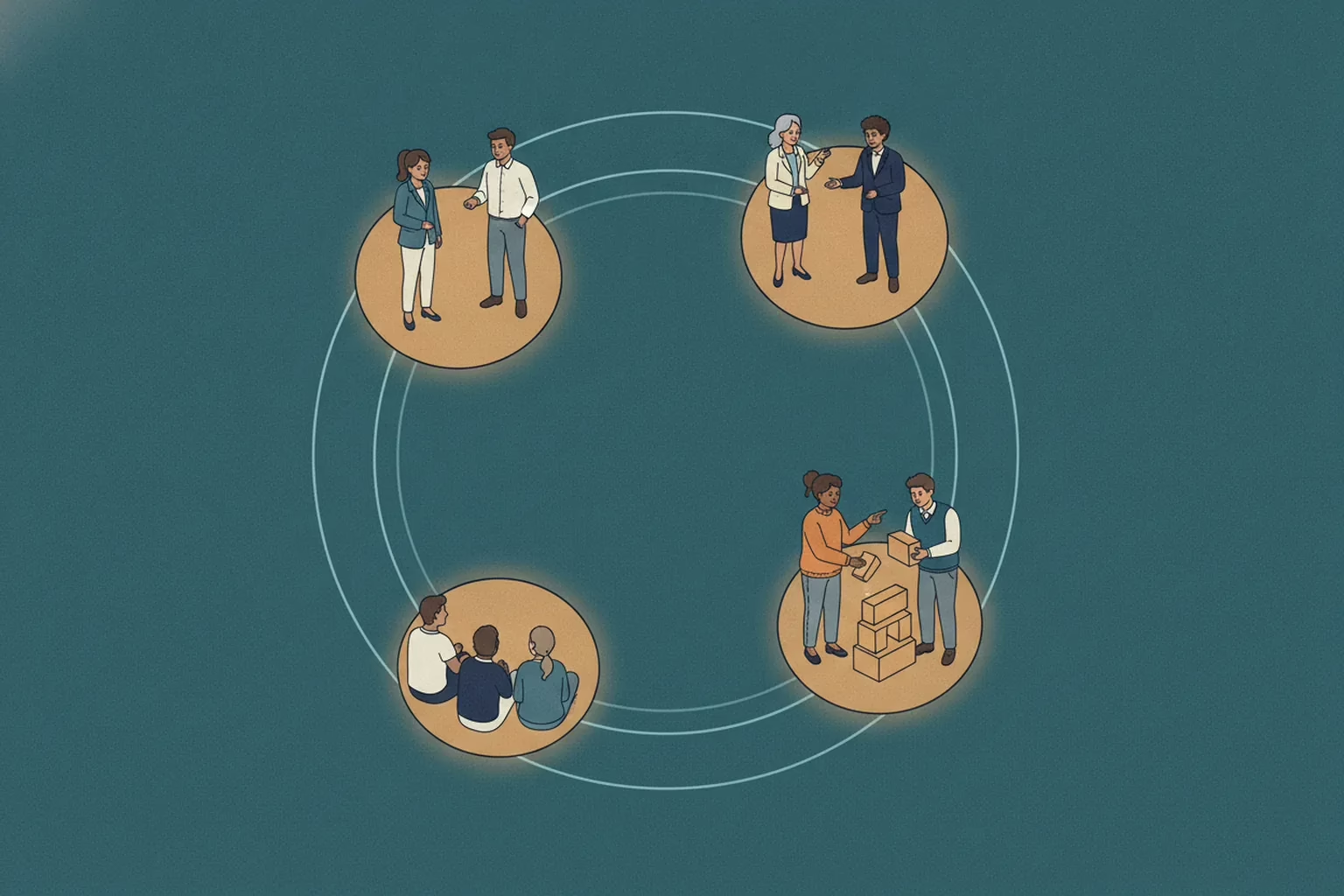
What is community engagement? It is the degree to which the people in your organization actually take part, rather than simply belong to it. A member who pays dues and never comes to anything is a member. A member who reads what you send, turns up sometimes, and occasionally answers somebody else’s question is engaged. The gap between those two is the thing every chamber, PTA, church, alumni network and nonprofit is trying to close, and it is why what is community engagement is a question worth answering carefully rather than in passing.
The phrase gets used loosely enough that it has started to mean nothing. It is worth pinning down, because what you decide it means determines what you measure, and what you measure determines what you spend your Tuesday nights on.
On this page
What is community engagement, in one sentence
Community engagement is the ongoing, two-way relationship between an organization and the people it exists for, measured by what those people do rather than by how many of them there are.
The formal definitions say something similar. The CDC’s community engagement materials describe it as working collaboratively with groups of people connected by geography, shared interest or similar circumstances to address things that affect them. That framing comes out of public health, but the useful part carries over: engagement is collaborative, it is ongoing, and it is defined by working with people rather than communicating at them.
For a membership organization, the practical version is shorter. Engagement is whether your people show up, speak up and stay.
The four parts of community engagement
Ask five people what is community engagement and you will usually get a single dimension back, most often attendance. It is more useful to think of four, because a group can be strong on one and hollow on the others.
1. Attention. Do your people actually receive and read what you send? This is the floor, and a surprising number of organizations fail it without knowing. If announcements go out on a platform that decides who sees them, attention is not something you have; it is something you are renting.
2. Attendance. Do they turn up to things? Meetings, events, calls, shifts. This is the most visible measure and the easiest to game with free food, which is why it should never be read on its own.
3. Contribution. Do they give something back? Time, money, an answer to somebody else’s question, a role they own. Contribution is where belonging turns into investment, and it is the strongest predictor that somebody will still be around next year.
4. Connection to each other. Do members know anyone besides you? This is the one most organizations never measure and the one that determines whether the group survives a change of leadership. If every relationship runs through the person in charge, you do not have a community, you have an audience with a mailing list.
A healthy organization has some strength in all four. A group with high attendance and no contribution is running a service, not a community. A group with high contribution from six people and no connection between the rest is one resignation away from trouble.
What community engagement is not
Half of answering what is community engagement is ruling out the things that get called engagement and are not. Mistaking them costs real time.
- It is not membership numbers. Headcount almost never goes down, so it tells you nothing about whether anything is working. A roster of 600 with 25 active people is a common and quiet failure.
- It is not social media metrics. Likes and follower counts measure a platform’s distribution decisions more than your members’ behaviour. They also disappear if the platform changes its mind.
- It is not communication volume. Sending more is the most common response to a quiet group and one of the least effective. Frequency without relevance trains people to ignore you.
- It is not satisfaction. Members can be perfectly happy with an organization they never think about. Satisfaction surveys mostly capture the opinions of the people who were already engaged enough to answer.
- It is not something you buy. Software removes admin so the human work is affordable. It does not do the human work.
What it looks like in different organizations
The answer to what is community engagement holds across organization types, but what counts as a good week looks quite different depending on who your members are.
- Chambers of commerce. Engagement shows up as members attending more than the one event they joined for, referring each other business, and renewing without a phone call. A chamber where renewals need chasing has an engagement problem wearing a billing costume.
- PTAs and school groups. Engagement is the number of distinct families who did something this year, not the same eight parents doing everything. The failure mode is a committee that never widens.
- Churches. Engagement is participation between services: small groups, volunteering, people checking on each other. Attendance on Sunday can stay flat while the rest quietly empties out.
- Nonprofits. Engagement covers donors, volunteers and program participants, and these need measuring separately. A donor who gives every year and never comes to anything is engaged in one sense and absent in another.
- Alumni networks. Engagement is whether local chapters run without the central office pushing them. It is the clearest case of connection to each other mattering more than connection to you.
- Support groups. Engagement is people returning and, eventually, speaking. Attendance is not enough on its own, and pushing for contribution too early has the opposite effect.
How community engagement is measured
Once you have settled what is community engagement, measuring it is the next problem, and since the four parts pull in different directions, one number will not cover them. A workable set is small enough to actually keep:
- Active members in the last 90 days. Anyone who attended, replied, volunteered or gave. Compare it to total membership and the honest picture appears quickly.
- Distinct participants, not total participations. Twelve people doing one thing each is a healthier number than three people doing four things each, even though the totals match.
- First-90-day activity for new members. Whether somebody does anything in their first three months predicts most of what follows.
- Repeat attendance. The share of attendees at an event who had been to something before. Rising means you are building a habit; flat means you are refilling a leaky bucket.
- Member-to-member interaction. Even a rough count of who answered whom. This is the one that tells you whether the group can outlast you.
Deliberately missing from that list: open rates and social reach. Open rates have been distorted by privacy features that load images automatically, so a healthy-looking rate can reflect a machine rather than a person, and reach on a social platform is a decision the platform makes. Neither one measures your members.
Where Kannect fits
Answering what is community engagement does not take software. Measuring it, and doing the small consistent things that raise it, is where most volunteer-led and small-staff organizations run out of hours. Kannect is a membership and community platform for any organization that has members, and it exists to make the four parts above cheap enough to keep up with.
- People CRM. Every person has a record with a status such as member, alumni, donor, staff, parent or student, so active and inactive are things you can actually see rather than guess at.
- Groups and programs. Chapters, committees and cohorts get their own spaces, which is how connection between members grows without every message going to everybody.
- Events with sign-ups. Attendance becomes a record instead of a memory, which is what makes repeat attendance measurable.
- Full membership management. One membership type with multiple pricing tiers on every plan, or multiple membership types each with their own tiers on higher plans, plus custom application forms, manual or automatic approval, a welcome flow, discounts and renewals.
- Email to your own list. Announcements reach the people you choose rather than whoever an algorithm decides to show them to, which is the difference between having attention and renting it.
- A member directory. One directory with unlimited listings on every plan, and multiple directories on higher plans, so members can find each other and not only you.
Pricing is public and there is no free plan. Every plan includes a 7-day trial and a card is required to start it.
| Plan | Monthly | Billed yearly | People | Admins | Emails/mo | Platform fee |
|---|---|---|---|---|---|---|
| Starter | $29 | $276 | 500 | 3 | 5,000 | 2% |
| Launch | $69 | $660 | 2,000 | 5 | 20,000 | 2% |
| Growth | $149 | $1,428 | 5,000 | 10 | 50,000 | 1.5% |
| Scale | $299 | $2,868 | 15,000 | 25 | 150,000 | 1% |
Payment processing is 2% on Starter and Launch, 1.5% on Growth and 1% on Scale. Donations to a registered nonprofit are processed at 0%.
Here is a short look at how it works:
Related reading
- Why engagement drops after the first event
- How to reach every member
- The hidden cost of running your group on Facebook
- The five tool community stack
- Stack audit calculator
Common questions about what community engagement is
What is community engagement in simple terms?
Community engagement is how much the people in your organization take part rather than simply belong. It covers whether they receive and read what you send, whether they turn up, whether they give something back, and whether they know each other. A group where all four are healthy is engaged; a group with a long roster and a quiet room is not, however large the roster.
What is the difference between community engagement and member engagement?
In practice they describe the same thing at different scopes. Member engagement usually refers to people who have formally joined and often gets measured through renewals and event attendance. Community engagement is broader and includes people who take part without a formal membership, such as volunteers, families, program participants and lapsed members who still show up.
Why does community engagement matter?
Because participation, not headcount, is what keeps an organization alive. Engaged members renew without chasing, volunteer, bring other people, and step into roles when leadership changes. Groups that track only membership numbers usually discover the problem at the point where nobody will take the chair position.
How do you measure community engagement?
Track active members in the last 90 days as a share of total membership, distinct participants rather than total participations, whether new members did anything in their first three months, repeat attendance at events, and how often members interact with each other rather than only with you. Avoid open rates and social reach, which measure a mail client or a platform more than they measure your members.
Is community engagement the same as social media engagement?
No. Social media engagement measures reactions on a platform that controls who sees your posts and can change that at any time. Community engagement measures what your members do, which is something you can observe and influence directly. The two can move in opposite directions, and often do.
What is a good community engagement rate?
There is no single benchmark, because a support group, a chamber and an alumni network are not comparable. The useful comparison is your own organization over time: is the share of members who did something in the last 90 days rising, and are new members active in their first three months. A rising trend on your own numbers matters more than anyone else’s average.
Where these definitions came from
Useful references on how community engagement is defined and structured:
Leave a comment